Overview
Photorefractive Keratectomy (PRK) is a type of laser eye surgery that corrects refractive errors by reshaping the cornea’s surface.
It’s ideal for those with thin corneas or unsuitable for LASIK.
PRK delivers excellent visual outcomes and long-term clarity with minimal complications.
Overview And Clinical Background
Laser surface reshaping for clear vision
PRK predates LASIK but remains a trusted choice, especially for patients with thinner corneas.
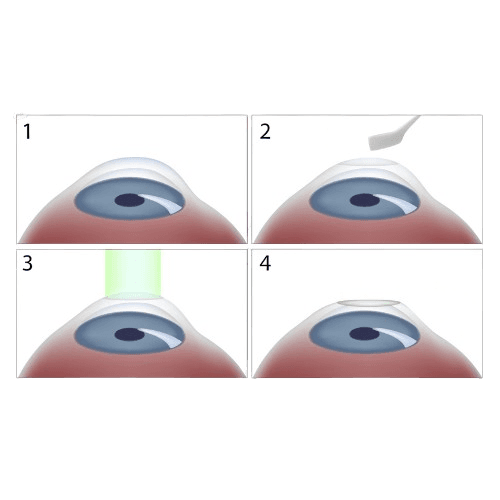
The procedure removes the surface layer (epithelium) before reshaping the cornea with an excimer laser.
- Purpose:: To correct myopia, hyperopia, and astigmatism.
- Technique:: Removes epithelium, reshapes cornea, allows natural regrowth.
- Recovery:: Vision improves gradually as the cornea heals.
Symptoms, Signs And Presentation
PRK candidates usually have refractive errors causing blurry vision.
Unlike LASIK, it’s preferred when corneal thickness limits flap creation.
- Blurry distance vision:: Due to myopia or astigmatism.
- Unsuitable for LASIK:: Thin or irregular corneas.
- Contact lens discomfort:: PRK provides a permanent alternative.
Diagnosis Methods And Investigations
Preoperative assessment
Detailed corneal mapping and stability testing ensure safety and eligibility.
- Corneal topography:: Analyzes shape and surface irregularities.
- Pachymetry:: Measures corneal thickness precisely.
- Refraction and pupil exam:: Determines correction degree and suitability.
Treatment Options And Surgical Techniques
PRK uses excimer laser reshaping without a corneal flap.
Healing is slightly longer but visual outcomes match LASIK.
- Epithelium removal:: Surface layer gently removed for laser access.
- Laser reshaping:: Excimer laser corrects the refractive error.
- Bandage lens:: Protects the cornea during early healing.
Recovery, Risks And Prognosis
Vision clears within days to weeks as the cornea regenerates.
Mild discomfort or light sensitivity is normal early on.
Long-term results are stable and excellent.
Why Choose Us
CureU Healthcare offers PRK with advanced laser systems and precise evaluation, ensuring safety and comfort for patients unsuitable for LASIK.
Conclusion
PRK provides freedom from glasses with lasting clarity.
CureU Healthcare ensures precise, safe, and patient-centered laser correction.

B.U.M.S, M.D. (NAT) | Reg No. 9153 | Ex. Secretary & Treasurer, N.I.M.A.
Qualified healthcare professional in Unani and Naturopathic medicine with deep expertise in traditional healthcare systems, patient-centered clinical care, and medical content review.