Overview
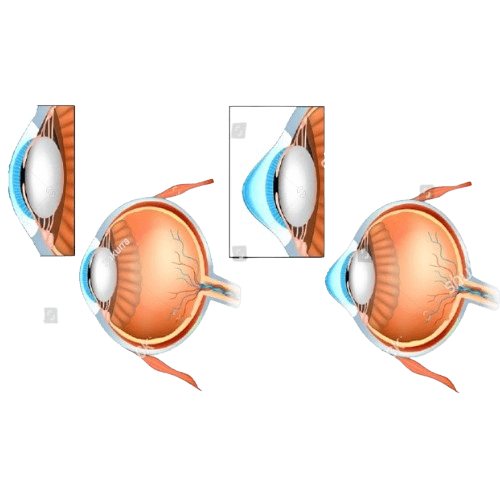
Intacs Corneal Implants are small, semicircular inserts placed within the cornea to reshape and stabilize it.
They’re primarily used to treat keratoconus and certain corneal ectasias, reducing irregular astigmatism and improving visual function when glasses or lenses are inadequate.
Overview And Clinical Background
Implantable corneal rings for stability
Intacs reshape the cornea mechanically rather than removing tissue.
By flattening the cone-shaped cornea in keratoconus, they restore more regular curvature and reduce distortion.
- Material:: Made from biocompatible PMMA designed for permanent placement.
- Mechanism:: Inserts act like supportive arcs to redistribute corneal stress.
- Indication:: Used when glasses or lenses no longer provide adequate vision.
Symptoms, Signs And Presentation
Keratoconus patients experience progressive vision distortion and intolerance to contact lenses.
Intacs can restore functional vision and delay or avoid corneal transplantation.
- Blurred or distorted vision:: Due to irregular corneal shape.
- Glare or halos:: Especially noticeable at night.
- Lens intolerance:: Contact lenses may become uncomfortable as keratoconus advances.
Diagnosis Methods And Investigations
Corneal mapping and thickness analysis
Thorough preoperative evaluation ensures corneal suitability and stability.
Advanced imaging defines implant placement and arc segment choice.
- Corneal topography:: Maps curvature irregularities and progression.
- Pachymetry:: Measures corneal thickness to ensure safe implant depth.
- Visual acuity and refraction:: Baseline metrics to assess improvement post-surgery.
Treatment Options And Surgical Techniques
The procedure is minimally invasive and performed under topical anesthesia.
Implants are inserted into corneal channels created with precision femtosecond laser guidance.
- Channel creation:: Laser or mechanical tunneling at defined corneal depth.
- Implant insertion:: PMMA arcs placed symmetrically to reshape curvature.
- Post-op care:: Antibiotic and steroid drops to promote healing and prevent infection.
Recovery, Risks And Prognosis
Vision typically improves within days to weeks.
Risks include infection, glare, or extrusion if corneal healing is poor, but most cases have durable results with proper follow-up.
Why Choose Us
CureU Healthcare’s corneal specialists use advanced imaging and precision lasers for optimal Intacs placement.
We emphasize customized correction and long-term stability.
Conclusion
Intacs offer a safe, reversible, and effective option to stabilize keratoconus.
At CureU Healthcare, early intervention can delay the need for corneal transplantation and preserve clear vision.