
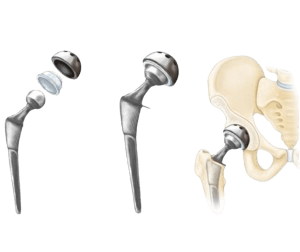
Overview
Partial hip replacement, also known as unilateral hip replacement, is a surgical procedure in which only the damaged femoral head of the hip joint is replaced while preserving the natural socket. It is commonly performed in cases of hip fractures or localized joint damage, especially in elderly patients. This targeted approach helps relieve pain, restore mobility, and maintain more natural joint mechanics compared to total hip replacement. Patients consult our verified orthopedic specialists to assess joint preservation.
Key Clinical Highlights
- Bone Preserving: Retains the natural socket while replacing only the damaged femoral head.
- Shorter Surgery: Less complex procedure compared to total hip replacement with reduced operative time.
- Faster Recovery: Allows early mobilization and quicker return to daily activities.
When to Consider
Partial hip replacement is considered for patients with femoral neck fractures, especially in elderly individuals, or when damage is limited to the femoral head without significant socket involvement. It is recommended when conservative treatments fail to relieve pain or when rapid mobilization is necessary to prevent complications such as immobility or prolonged bed rest.
Restore Mobility After Hip Damage
The procedure helps patients regain mobility and reduce pain when the femoral head is severely damaged.
- Pain Relief: Removes damaged bone causing severe hip pain.
- Early Mobilization: Helps patients walk sooner after surgery.
- Joint Stability: Restores hip alignment and function effectively.
Symptoms and Indications
- Severe Hip Pain: Persistent pain affecting daily movement.
- Limited Mobility: Difficulty walking or standing.
- Hip Fracture: Break in the femoral neck requiring surgical intervention.
- Joint Instability: Loss of balance or support in the hip joint.
Types of Partial Hip Replacement (Unilateral Hip Replacement)
Hemiarthroplasty
Replacement of only the femoral head while preserving the natural acetabulum.
- Unipolar: Single-piece prosthesis with movement between implant and socket.
- Bipolar: Dual articulation design reducing wear and improving mobility.
Cemented vs Uncemented
Implant fixation methods depending on bone quality.
- Cemented Implant: Uses bone cement for immediate fixation, commonly in elderly patients.
Pre-Procedure Preparation
- Medical Evaluation: Complete health and imaging assessment at our accredited partner hospitals.
- Medication Review: Adjust medications before surgery.
- Fasting: Avoid food before procedure.
- Prehab: Strengthening exercises if possible.
Treatment Stages
- Pre Arrival (Day 1): Consultation and planning
- Admission (Week 1): Evaluation and preparation
- Surgery (Week 2): Partial hip replacement procedure
- Recovery (Weeks 2-6): Rehabilitation and discharge
Recovery Guidelines
- Use Support: Walk with assistance initially to avoid sudden mechanical strain.
- Physiotherapy: Essential for restoring strength and motion.
- Avoid Strain: Limit stress on operated hip.
- Follow Up: Regular monitoring for implant function.
Life After Treatment
- Patients regain mobility within weeks.
- Pain significantly reduces after surgery.
- Improved independence in daily life.
Partial hip replacement restores function while preserving natural joint structure.
Potential Risks
- Dislocation: Joint may dislocate if precautions are not followed.
- Infection: Possible at surgical site but manageable.
- Implant Wear: Long term wear may require revision surgery.
Cost Estimation in India
Estimated procedure package range: $4,000 to $9,000 USD.
Package Inclusions:
- Pre-surgery tests
- Implant and surgery
- Hospital stay
- Surgeon fees
Global Cost Comparison
- USA: $35,000 USD
- UK: $28,000 USD
- Germany: $25,000 USD
- Thailand: $12,000 USD
- India: $7,000 USD

B.U.M.S, M.D. (NAT) | Reg No. 9153 | Ex. Secretary & Treasurer, N.I.M.A.
Qualified healthcare professional in Unani and Naturopathic medicine with deep expertise in traditional healthcare systems, patient-centered clinical care, and medical content review.