Overview
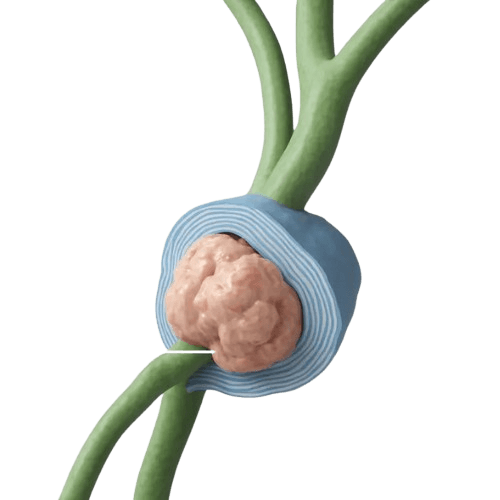
Schwannomas are benign tumors arising from Schwann cells, which form the protective covering of peripheral nerves.
They can occur anywhere along the nervous system and may cause pain, numbness, or weakness depending on location.
CureU Healthcare offers precise diagnosis using imaging and neuro-monitoring, and treatment plans tailored to each patient to preserve nerve function.
Overview And Clinical Background
Understanding Schwannoma Formation
Schwannomas develop from Schwann cells surrounding peripheral nerves.
These tumors are usually slow-growing and benign, but their size and location can compress nearby nerves causing symptoms.
- Tumor origin:: Arises from the myelin-producing Schwann cells.
- Typically solitary and encapsulated.
- Clinical impact:: Symptom severity depends on nerve compression.
Symptoms, Signs And Presentation
Symptoms vary depending on tumor size and location.
They may include localized pain, numbness, tingling, or weakness along the affected nerve pathway.
- Common symptom:: Painless lump or swelling along a nerve.
- Numbness, tingling, or weakness in the limb.
- Red flag:: Rapid growth, severe pain, or neurological deficits requiring urgent evaluation.
Diagnosis Methods And Investigations
Imaging And Nerve Studies
Diagnosis relies on MRI, CT, and sometimes biopsy to confirm the benign nature.
Nerve conduction studies assess functional impact.
- Imaging:: MRI or CT to visualize tumor size, location, and relation to nerves.
- Lab tests:: Generally not required unless biopsy is planned.
- Electromyography to evaluate nerve function if affected.
Treatment Options And Surgical Techniques
Small, asymptomatic schwannomas may be monitored, while symptomatic tumors require surgical removal.
Microsurgical techniques are preferred to preserve nerve function.
- Conservative:: Observation for small, asymptomatic tumors.
- Minimally invasive options:: Stereotactic radiosurgery for select tumors.
- Open surgical excision with nerve preservation for symptomatic or growing tumors.
Recovery, Risks And Prognosis
Recovery depends on tumor location and surgery complexity.
Most patients regain function, though temporary numbness or weakness may occur.
Prognosis is excellent for benign tumors when treated appropriately.
Why Choose Us
CureU Healthcare provides expert neurosurgical and neurological care for schwannomas.
Advanced imaging, microsurgery, and multidisciplinary planning ensure optimal outcomes and minimal nerve damage.
Conclusion
Schwannomas are typically benign and treatable.
With expert care at CureU Healthcare, patients can achieve excellent recovery while preserving nerve function.