
Overview
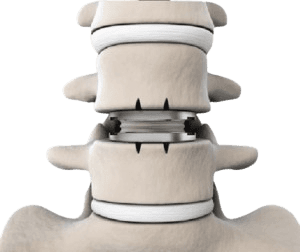
An artificial spine lumbar disk replacement is a surgical procedure to remove and replace the damaged or worn disk material between the small bones in the spine (vertebrae). The replacement occurs with an artificial prosthetic or artificial disk. In essence, the main aim of the removal and replacement is to relieve pain symptoms while maintaining the normal motion and function. However, it is allowed with some other procedures, such as spinal fusion. For instance, the approximate estimate is that 70 to 80% of people will experience low back pain at some point in their lives; nevertheless, some of them can improve with non-surgical treatments.
Surgery is only recommended when other non-surgical treatments fail to relieve symptoms. Typically, pain should be caused by one or two worn-out (arthritic) discs, which can be diagnosed through tests and a physical check-up. Moreover, when the patient has already gone through fusion surgery that heals perfectly but ends up with no pain improvement, further evaluation is needed.
The belief of failure to improve after fusion surgery is due to the reason that fusion prevents normal motion in the spine. Artificial disc replacement helps to preserve normal motion that leads to perfect treatment for low back pain.
Understanding the eligibility for lumbar disk replacement
Before considering the condition of lumbar disk replacement surgery, doctors may need some tests such as:
- X rays
- Computed tomography (CT) scan
- Discography
- Magnetic resonance imaging (MRI) scans
These tests clarify the source of pain and examine the condition from inside. Artificial disk replacement is not recommended for all the patients with low back pain. The candidates for disk replacement have these characteristics:
- Back pain caused by one or two arthritic intervertebral disks in the lumbar spine.
- No osteoporosis (weak bone)
- No deformity of the spine
- No previous surgery on the lumbar spine
- The body should not be extremely overweight
- No significant facet joint disease or bony compression on spinal nerves
Surgical procedure to perform artificial spine lumbar disk replacement
Artificial disk replacement surgery procedure takes almost 2 to 3 hours
The surgeon makes an incision to the lower back from the front in the abdomen.
This helps to get complete access to the spine too without moving the nerves.
This approach moved the organs and blood vessels to the side.
This surgery is a combination of surgeons. An orthopedic surgeon and a vascular surgeon that opens the disk space .
This surgery performs the removal of the damaged disc and replaces it with an artificial prosthetic into the disk space.
While ensuring the placement of the implant, doctors close the incision.
Design of the disk
Some disk replacement devices comprise the nucleus center of the intervertebral disk that leaves the annulus in place.
Total artificial disk replacement, the alternative of the annulus and nucleus with a mechanical device.
There are various different designs that have their own purpose of giving relief to the different symptoms. Although each maintains a similar aim to reproduce the size and function to a normal intervertebral disk.
The material used for the disk is metal, while some are made up with a combination of metal and plastic, similar to joint replacement in the knee hip.
Cost of artificial spine lumbar disk replacement in India
The cost of an artificial spine lumbar disk replacement in India is affordable and reasonable as compared to the other developed countries. India maintains the best quality equipment that is implanted in the patient's replacement surgery. Delivery excellent results without straining finances.
However, the overall cost of the treatment may vary depending on several factors. These factors include the surgeon’s expertise, the type of implant, the location of the hospital, and more.
Summary
An artificial spine lumbar disk replacement is a surgical procedure to remove and replace the damaged or worn disk material between the small bones in the spine (vertebrae).
The main aim of the removal and replacement is to relieve pain symptoms while maintaining the normal motion and function.
Surgery is only recommended when other non-surgical treatments fail to relieve symptoms.

B.U.M.S, M.D. (NAT) | Reg No. 9153 | Ex. Secretary & Treasurer, N.I.M.A.
Qualified healthcare professional in Unani and Naturopathic medicine with deep expertise in traditional healthcare systems, patient-centered clinical care, and medical content review.