Overview
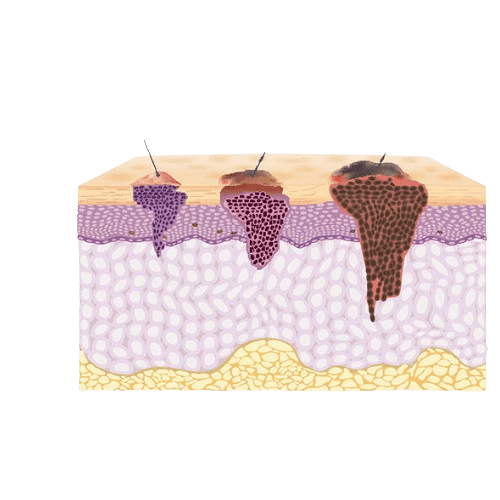
Melanoma arises from pigment-producing melanocytes and can develop on any skin surface, including areas not heavily sun-exposed.
It tends to invade deeper skin layers and metastasize earlier than most non-melanoma skin cancers, so early recognition and staging are essential.
Treatment is stage-dependent and may include wide local excision, sentinel node assessment, targeted therapy or immunotherapy for advanced disease, and long-term surveillance.
Overview And Clinical Background
Biology, risk factors and clinical importance
Melanoma is biologically distinct from basal or squamous cell cancers and is driven by mutations (eg. BRAF, NRAS) in many cases.
UV exposure, intermittent sunburns, fair skin, family history, and numerous or atypical moles increase risk, while genetic testing and dermoscopic screening aid early detection.
- Cell of origin: Melanocytes — pigment-producing cells in the epidermis — transform and gain the ability to invade local tissue and enter lymphatic or blood vessels, leading to metastasis if unchecked; molecular profiling often identifies actionable mutations.
- Risk profile: Intense intermittent UV exposure, history of sunburns, numerous or changing moles, immunosuppression, and family history raise melanoma risk and warrant proactive surveillance.
- Clinical impact: Because melanoma can metastasize at an early stage, staging and sentinel node assessment directly influence prognosis and the choice of adjuvant systemic therapies.
Symptoms, Signs And Presentation
Melanoma commonly appears as a new or changing pigmented lesion; the ABCDE rule (Asymmetry, Border irregularity, Color variation, Diameter >6mm, Evolution) helps clinical recognition.
Early lesions may be subtle, and any rapidly changing spot or lesion that itches, bleeds or ulcerates should prompt urgent dermatologic evaluation.
- Typical appearance: A mole or pigmented patch that is asymmetric, has irregular borders, multiple colors, or is enlarging over weeks to months — these features suggest malignant transformation and need biopsy.
- Local symptoms: Itching, tenderness, bleeding, or surface breakdown can occur as the lesion progresses and are red flags for deeper invasion or secondary infection.
- Advanced signs: Palpable regional lymph nodes, non-healing ulceration, or systemic symptoms such as weight loss and persistent fatigue may indicate regional or distant spread and require rapid staging.
Diagnosis Methods And Investigations
Dermoscopy, biopsy and molecular testing
Diagnosis relies on clinical inspection with dermoscopy followed by an excisional or incisional biopsy for histopathology.
Staging uses sentinel lymph node biopsy for appropriate lesions and cross-sectional imaging (CT, PET-CT or MRI) when metastatic disease is suspected.
- Biopsy: Complete excisional biopsy with narrow margins (or deep incisional biopsy if excision not feasible) yields definitive histology, Breslow thickness measurement and mitotic rate which guide staging and management.
- Sentinel node assessment: Sentinel lymph node biopsy for intermediate- to high-risk melanomas identifies occult nodal disease and refines prognosis and need for adjuvant therapy.
- Molecular profiling: Testing for mutations such as BRAF, NRAS and KIT informs eligibility for targeted agents and clinical trials, particularly in advanced or recurrent disease.
Treatment Options And Surgical Techniques
Definitive management for localized melanoma is surgical — wide local excision with margins determined by Breslow thickness; sentinel node biopsy is performed when indicated.
Advanced disease is treated with systemic immunotherapies (checkpoint inhibitors), targeted therapies for actionable mutations, and stereotactic radiotherapy or surgery for limited metastases.
- Surgical excision: Wide local excision with guideline-driven margins removes the primary tumor and reduces local recurrence risk; reconstructive techniques restore form and function when lesions are in cosmetically sensitive areas.
- Nodal management: Sentinel lymph node biopsy identifies microscopic spread; therapeutic lymphadenectomy may be needed for clinically positive nodes combined with adjuvant systemic therapy based on stage.
- Systemic therapies: Immune checkpoint inhibitors (eg. anti-PD-1) and BRAF/MEK targeted combinations for BRAF-mutant melanomas have transformed outcomes in metastatic disease and are integrated into stage-appropriate care plans.
Recovery, Risks And Prognosis
Prognosis is closely linked to tumor thickness, ulceration and nodal status; thin, early melanomas have excellent cure rates after excision, while nodal or distant involvement reduces long-term survival but may respond to modern systemic therapy.
Follow-up schedules are risk-adapted and include periodic skin exams and imaging when indicated.
Why Choose Us
CureU Healthcare combines experienced dermatologic surgeons, oncology, molecular diagnostics and reconstructive expertise to deliver comprehensive melanoma care.
We offer rapid diagnostic pathways, access to targeted and immunotherapies, and survivorship programs that emphasise functional and cosmetic outcomes alongside oncologic control.
Conclusion
Melanoma requires early recognition, accurate staging and coordinated multidisciplinary care.
With prompt surgical management and modern systemic options, many patients achieve durable control and meaningful long-term survival.

B.U.M.S, M.D. (NAT) | Reg No. 9153 | Ex. Secretary & Treasurer, N.I.M.A.
Qualified healthcare professional in Unani and Naturopathic medicine with deep expertise in traditional healthcare systems, patient-centered clinical care, and medical content review.