
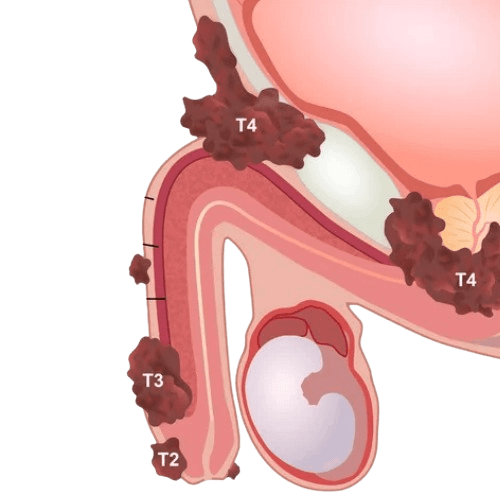
Overview
Penile cancer arises from the surface epithelium of the penis, most commonly as squamous cell carcinoma.
Early detection offers high cure rates with conservative surgery or topical therapies, while advanced disease may require partial or total penectomy with nodal dissection.
Preventive measures such as good hygiene, circumcision, and HPV vaccination significantly lower risk.
Overview And Clinical Background
Rare but impactful urologic malignancy
Penile cancer is uncommon and often linked to poor hygiene, phimosis, chronic inflammation, or HPV infection.
It affects mostly older men, but awareness and early evaluation prevent major functional loss.
- Common type: Squamous cell carcinoma represents over 90% of penile cancers.
- Risk factors: HPV infection, chronic irritation, phimosis, and smoking.
- Prevention: Circumcision in early life and HPV vaccination reduce incidence.
Symptoms, Signs And Presentation
Early lesions may appear as painless growths, ulcers, or red patches on the glans or foreskin.
Neglect often leads to deeper invasion and lymph node spread.
- Visible lesion: Non-healing sore, wart-like growth, or ulcer on penile skin.
- Pain or discharge: Later stages may involve pain, discharge, or bleeding.
- Lymph node swelling: Groin swelling due to nodal metastasis.
Diagnosis Methods And Investigations
Clinical evaluation and biopsy
Diagnosis is confirmed by biopsy of the lesion.
Imaging such as MRI or CT assesses local invasion and lymph node involvement.
- Biopsy: Definitive diagnosis based on histopathology.
- MRI pelvis: Assesses extent of invasion into corpora or urethra.
- CT or PET-CT: Staging for nodal and distant spread.
Treatment Options And Surgical Techniques
Management depends on stage — early lesions may be treated with laser, topical agents, or partial surgery; advanced cases need radical penectomy with lymph node dissection.
Organ-sparing approaches are prioritised when oncologically safe.
- Local therapy: Laser ablation or topical 5-FU for superficial lesions.
- Surgical excision: Partial or total penectomy based on depth and extent.
- Nodal management: Inguinal lymph node dissection for confirmed spread.
Recovery, Risks And Prognosis
Early detection ensures good outcomes and organ preservation.
Advanced cases carry poorer prognosis, but reconstructive options and counselling improve recovery and sexual health.
Why Choose Us
CureU Healthcare offers advanced diagnostics, reconstructive urology, and comprehensive cancer support for penile malignancies.
We combine expert surgical precision with psychological and rehabilitative care.
Conclusion
Penile cancer, though rare, is highly treatable when identified early.
Awareness, hygiene, and HPV vaccination are key to prevention and preservation of function.

B.U.M.S, M.D. (NAT) | Reg No. 9153 | Ex. Secretary & Treasurer, N.I.M.A.
Qualified healthcare professional in Unani and Naturopathic medicine with deep expertise in traditional healthcare systems, patient-centered clinical care, and medical content review.