
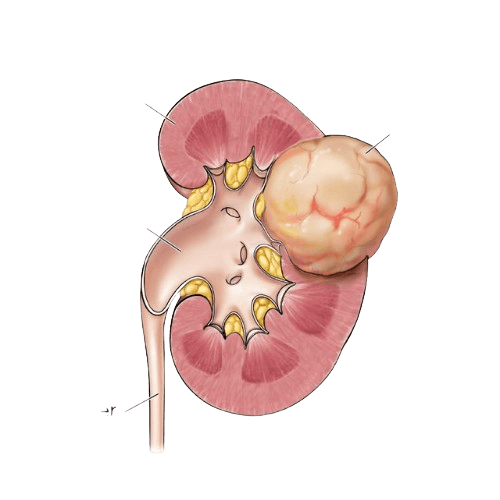
Overview
Kidney cancer typically starts in the lining of small tubes in the kidney and may be discovered incidentally on imaging or present with blood in the urine, flank pain, or a palpable mass.
Management is stage-directed and may include partial or radical nephrectomy, ablation, targeted therapy, or immunotherapy.
The goal is cure for localized disease, preservation of renal function when possible, and coordinated long-term surveillance.
Overview And Clinical Background
Origin, types and clinical importance
Most primary kidney cancers are renal cell carcinomas arising from the renal tubular epithelium.
Subtypes (clear cell, papillary, chromophobe) differ in biology and targeted treatment sensitivity.
- Common subtype: Clear cell RCC is the most frequent and has characteristic vascular features.
- Risk factors: Smoking, obesity, hypertension, and certain hereditary syndromes increase risk.
- Natural history: Small lesions may be indolent; larger or high-grade tumors can metastasize to lung or bone.
Symptoms, Signs And Presentation
Early kidney cancer may be asymptomatic and found during unrelated imaging.
When symptomatic, patients report hematuria, flank pain, or a palpable lump; paraneoplastic syndromes occasionally appear.
- Hematuria: Painless blood in the urine is a classic presenting sign.
- Flank discomfort: Dull ache or fullness around the affected kidney.
- Systemic signs: Unintended weight loss, fever, or fatigue may indicate advanced disease.
Diagnosis Methods And Investigations
Imaging, biopsy and staging
Diagnosis uses ultrasound, contrast CT or MRI to characterise renal masses and CT chest/abdomen/pelvis or PET for staging.
Percutaneous biopsy is used selectively to guide management when imaging is indeterminate.
- Cross-sectional imaging: Contrast CT or MRI to evaluate size, local invasion and vascular involvement.
- Image-guided biopsy: Core biopsy when histology will change management or for systemic therapy planning.
- Staging workup: CT chest and bone scans/PET for suspected metastatic disease.
Treatment Options And Surgical Techniques
Treatment depends on size, location and stage — options include active surveillance for small lesions, partial nephrectomy to spare renal tissue, radical nephrectomy for larger tumors, ablative therapies, and systemic targeted or immune therapies for advanced disease.
Minimally invasive and robotic approaches reduce recovery time when feasible.
- Nephron-sparing surgery: Partial nephrectomy removes the tumor while preserving healthy kidney tissue.
- Radical nephrectomy: Complete kidney removal for large or centrally located tumors.
- Systemic therapy: Tyrosine kinase inhibitors, immune checkpoint inhibitors, or combination regimens for metastatic disease.
Recovery, Risks And Prognosis
Recovery after surgery typically spans weeks with progressive return to activity.
Prognosis is excellent for localized cancers treated early; metastatic disease prognosis has improved substantially with modern systemic therapies but requires long-term management.
Why Choose Us
CureU Healthcare offers multidisciplinary kidney cancer care — precision imaging, experienced urologic surgeons trained in nephron-sparing techniques, and access to targeted and immunotherapies.
We personalise treatment to maximise cure while protecting renal function and quality of life.
Conclusion
Kidney cancer is often curable when detected early and managed by an expert team.
Timely imaging, kidney-sparing surgery when possible, and modern systemic options provide the best long-term outcomes.

B.U.M.S, M.D. (NAT) | Reg No. 9153 | Ex. Secretary & Treasurer, N.I.M.A.
Qualified healthcare professional in Unani and Naturopathic medicine with deep expertise in traditional healthcare systems, patient-centered clinical care, and medical content review.