Overview
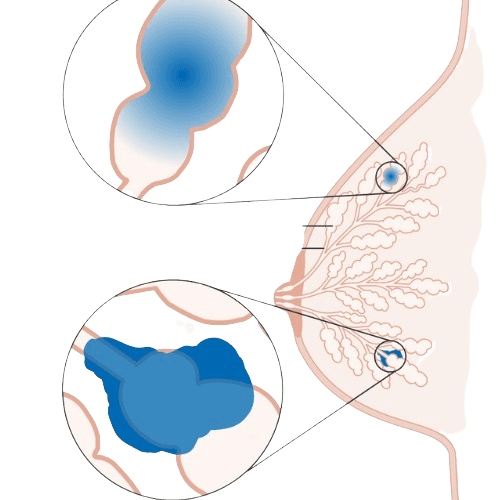
Invasive Lobular Carcinoma begins in the milk-producing lobules and often grows in a single-file pattern that can be harder to detect on mammography.
ILC tends to be hormone receptor–positive and responsive to endocrine therapy; management is individualized using multimodality treatment to maximise cure while preserving form and function.
Overview And Clinical Background
Distinct pathology and detection challenges
ILC accounts for a significant minority of breast cancers and has a characteristic infiltrative growth pattern.
Its imaging appearance may be subtle, so MRI and careful clinical examination are useful when suspicion is high.
- Growth pattern: Single-file infiltration of tumor cells with often ill-defined borders on imaging.
- Receptor status: Frequently estrogen receptor–positive and HER2-negative.
- Detection: May require multi-modality imaging (mammogram, ultrasound, MRI) for accurate mapping.
Symptoms, Signs And Presentation
Patients may notice subtle thickening, fullness, or shape change rather than a distinct lump.
Nipple changes or skin tethering can occur in more advanced cases.
- Palpable change: Diffuse thickening or an ill-defined area rather than a discrete mass.
- Imaging clues: Asymmetry or architectural distortion on mammography.
- Red flag: Rapid size change, persistent nipple retraction or discharge.
Diagnosis Methods And Investigations
Biopsy and receptor testing
Core needle biopsy confirms diagnosis and provides receptor and molecular status to guide systemic therapy.
Staging uses breast MRI and axillary assessment as appropriate.
- Core biopsy: Histologic confirmation with evaluation of ER/PR/HER2 status.
- Breast MRI: Helpful for extent-of-disease assessment, especially in dense breasts.
- Axillary staging: Sentinel lymph node biopsy to assess spread when surgery is planned.
Treatment Options And Surgical Techniques
Surgery (breast-conserving surgery or mastectomy) is the cornerstone for localized ILC with sentinel node assessment.
Most patients with hormone receptor–positive disease receive endocrine therapy; chemo and radiotherapy are used based on stage and risk.
- Surgical options: Lumpectomy with clear margins or mastectomy depending on extent and patient preference.
- Systemic therapy: Endocrine therapy (tamoxifen or aromatase inhibitors) for ER-positive disease; chemotherapy for higher-risk biology.
- Radiotherapy: Adjuvant radiation after breast-conserving surgery or for selected high-risk cases.
Recovery, Risks And Prognosis
Recovery follows the chosen surgical approach; prognosis is often favorable for hormone-sensitive, node-negative disease.
Long-term endocrine therapy and surveillance reduce recurrence risk.
Why Choose Us
CureU Healthcare provides breast-conserving and reconstructive surgery, MRI-guided planning, precise pathology and personalised endocrine management.
We deliver coordinated care that balances cure with cosmesis and quality of life.
Conclusion
Invasive Lobular Carcinoma is a treatable breast cancer that benefits from careful imaging, accurate pathology and targeted systemic therapy.
Early multidisciplinary management maximises outcomes and options for breast preservation.