Overview
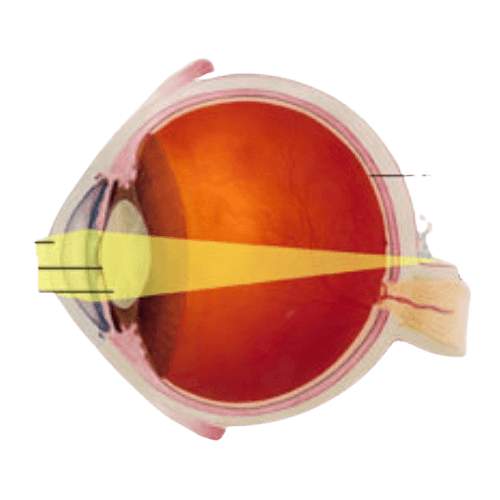
Hyperopia, or farsightedness, is a common refractive error where light focuses behind the retina instead of on it.
This makes near vision blurry while distance vision remains clearer. Treatment ranges from corrective lenses to refractive laser procedures for permanent correction.
Overview And Clinical Background
Refractive error causing near blur
Hyperopia results from a shorter eyeball or flatter cornea, causing incoming light to focus behind the retina.
It can affect all age groups but often becomes more noticeable with age as the eye loses focusing power.
- Anatomy:: Occurs when the eye’s optical power is insufficient for its length.
- Symptoms onset:: More noticeable during reading or prolonged near work.
- Correction methods:: Spectacles, contact lenses, or refractive surgery restore focus.
Symptoms, Signs And Presentation
Patients may complain of eyestrain, headaches, or blurred near vision after reading.
Children may appear inattentive or avoid close-up tasks due to eye fatigue.
- Blurry near vision:: Main symptom especially during close work.
- Headaches or strain:: Due to constant focusing effort.
- Squint or eye turn:: Seen in children when uncorrected hyperopia is significant.
Diagnosis Methods And Investigations
Eye examination and refraction
Diagnosis is straightforward using refraction tests.
Children and adults benefit from cycloplegic refraction to accurately measure hidden hyperopia.
- Visual acuity test:: Determines clarity at different distances.
- Retinoscopy:: Objective measure of refractive error under dilation.
- Autorefraction and keratometry:: Quantifies refractive status and corneal curvature.
Treatment Options And Surgical Techniques
Hyperopia can be corrected with lenses or refractive surgery.
The goal is to bring the focus point onto the retina for clear vision at all distances.
- Glasses or contacts:: Provide immediate correction and comfort.
- LASIK or PRK:: Reshape cornea to permanently correct mild to moderate hyperopia.
- Refractive lens exchange:: Option for high hyperopia or older adults with early presbyopia.
Recovery, Risks And Prognosis
Glasses offer instant clarity; surgical correction usually stabilizes within weeks.
Risks depend on the chosen method but success rates are high with proper screening.
Why Choose Us
CureU Healthcare provides comprehensive refractive care — from diagnosis to laser correction — using advanced technology and personalized plans.
Our goal is lasting visual comfort and precision.
Conclusion
Hyperopia is easily manageable with modern optics or surgery.
At CureU Healthcare, our specialists help you achieve clear, comfortable vision suited to your lifestyle.