Overview
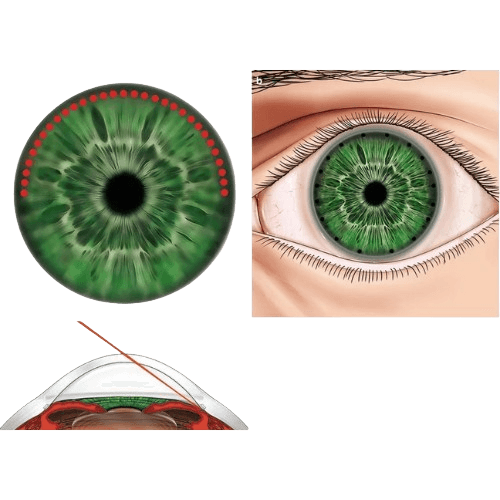
Gonioplasty, also known as Iridoplasty, is a laser procedure that reshapes the peripheral iris to open the drainage angle of the eye.
It’s primarily performed in patients with narrow or closed angles, often to prevent glaucoma attacks or reduce intraocular pressure. The laser gently contracts small areas of the iris, pulling it away from the trabecular meshwork and improving fluid outflow.
Overview And Clinical Background
Laser reshaping of the iris
Gonioplasty modifies the iris configuration to improve aqueous humor drainage.
It’s a non-invasive adjunct treatment for angle-closure or narrow-angle glaucoma, helping to restore normal pressure dynamics within the eye.
- Mechanism:: Laser burns cause local contraction, flattening the peripheral iris to widen the drainage angle.
- Indications:: Used when the angle remains narrow despite iridotomy or when angle crowding persists.
- Goal:: To prevent angle closure and subsequent optic nerve damage.
Symptoms, Signs And Presentation
Patients eligible for gonioplasty often have narrow or occludable angles that may cause intermittent eye pain or blurred vision.
Some present with elevated intraocular pressure detected during routine exams.
- Eye pain or headache:: Caused by intermittent angle closure increasing intraocular pressure.
- Blurred vision:: Occurs due to pressure spikes or shallow anterior chamber.
- Asymptomatic cases:: Discovered during preventive glaucoma screening.
Diagnosis Methods And Investigations
Preoperative angle assessment
Assessment focuses on visualizing and grading the drainage angle to plan laser application.
Accurate diagnosis ensures that Gonioplasty is indicated and safe.
- Gonioscopy:: Primary diagnostic tool to visualize angle width and configuration.
- Anterior segment OCT:: Provides detailed imaging of iris and angle anatomy.
- Intraocular pressure measurement:: Monitors glaucoma control before and after the procedure.
Treatment Options And Surgical Techniques
The laser procedure is done under topical anesthesia and typically lasts only a few minutes.
It’s painless and performed in an outpatient setting.
- Laser type:: Argon or diode laser applied in concentric spots on the peripheral iris.
- Technique:: Laser energy causes controlled iris contraction, widening the angle.
- Post-procedure care:: Anti-inflammatory drops prevent temporary inflammation or pressure spikes.
Recovery, Risks And Prognosis
Most patients resume normal activities the same day.
Mild discomfort or light sensitivity may occur temporarily. The procedure successfully widens the angle in most cases and prevents future pressure crises.
Why Choose Us
CureU Healthcare’s glaucoma specialists use precise laser settings tailored to your eye’s anatomy.
We combine imaging, expertise, and close monitoring for safe, effective outcomes.
Conclusion
Gonioplasty is a simple yet effective solution to maintain open angles and prevent glaucoma progression.
Early evaluation and treatment can preserve lifelong vision with minimal risk.