Overview
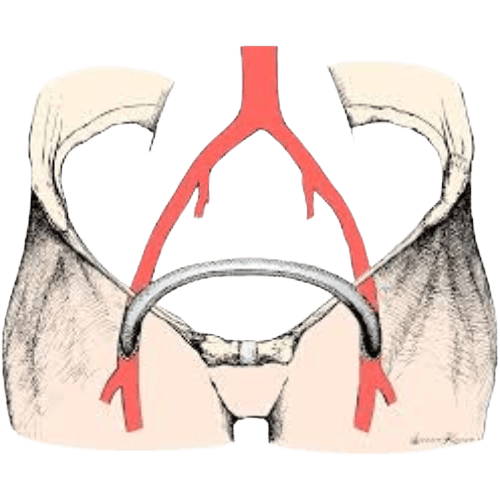
Femorofemoral bypass is an extra-anatomic vascular bypass that connects the common femoral arteries to reroute blood around an obstructed iliac or external iliac segment.
It is commonly used when a direct aortoiliac reconstruction carries excessive risk or is anatomically unsuitable.
The procedure uses a synthetic graft tunneled subcutaneously to restore durable limb perfusion, relieve ischemic pain, heal ulcers, and reduce the risk of limb loss.
Overview And Clinical Background
Extra-anatomic route to revascularize the leg
Femorofemoral bypass creates a conduit between a well-perfused femoral artery and the contralateral femoral artery to bypass occlusive disease.
It is indicated for unilateral aortoiliac occlusive disease, selected restenosis after endovascular therapy, or when general aortic surgery is high-risk.
- Indication: Used for significant unilateral iliac occlusive disease when less invasive endovascular options have failed or anatomy favors an extra-anatomic solution; it restores distal perfusion and improves walking distance and wound healing.
- Graft choice: Synthetic grafts such as Dacron or PTFE are commonly used for long-term patency; selection depends on patient factors and surgeon preference with attention to infection risk and limb runoff.
- Expected benefit: Provides symptomatic relief of claudication, heals ischemic ulcers, and can prevent limb loss when successful, with durable mid- and long-term results in appropriately selected patients.
Symptoms, Signs And Presentation
Patients considered for femorofemoral bypass typically present with lifestyle-limiting claudication, rest pain, or tissue loss in the affected limb.
Examination and noninvasive tests document decreased distal pulses and reduced ankle pressures.
- Claudication: Cramping or aching pain in the calf or buttock triggered by walking and relieved by rest, progressively limiting distance and quality of life.
- Ischemic rest pain or ulceration: Continuous foot or forefoot pain at rest, non-healing ulcers, or gangrenous changes that indicate critical limb ischemia requiring revascularization.
- Physical findings: Diminished femoral or distal pulses on the affected side, cool extremity, and sometimes trophic skin changes indicating chronic poor perfusion.
Diagnosis Methods And Investigations
Imaging and physiologic assessment
Careful preoperative assessment defines anatomy and the best revascularization strategy.
Imaging evaluates inflow, outflow, and landing zones for grafts while physiologic tests quantify ischemia severity.
- Duplex ultrasound: Noninvasive first-line test that identifies flow-limiting lesions, estimates stenosis severity and evaluates distal runoff to predict graft success.
- CT angiography: High-resolution mapping of aortoiliac and femoral anatomy to plan graft length, tunnel route and detect calcification that may affect anastomotic technique.
- Ankle-brachial index (ABI): Simple bedside measurement comparing ankle and brachial pressures to quantify limb ischemia and monitor response to revascularization.
Treatment Options And Surgical Techniques
Femorofemoral bypass is performed under regional or general anesthesia via incisions in both groins; the graft is tunneled subcutaneously to create a cross-femoral conduit.
Technical details, conduit choice and adjunctive procedures are tailored to patient anatomy and comorbidity.
- Surgical steps: Exposure of both common femoral arteries, systemic heparinization, end-to-side anastomosis of a synthetic graft to the donor femoral artery, tunnelling the graft and completing the recipient anastomosis with careful hemostasis.
- Adjunct procedures: Concurrent femoral endarterectomy, patch angioplasty or distal angioplasty may be performed to optimize inflow and outflow and improve graft patency.
- Endovascular alternative: When suitable, percutaneous transluminal angioplasty with or without stenting of the aortoiliac segment is preferred; fem-fem remains a durable alternative when endovascular therapy is not feasible.
Recovery, Risks And Prognosis
Hospital stay typically ranges from 3–7 days depending on comorbidities and wound healing.
Early ambulation and antiplatelet therapy support graft patency, while surveillance duplex scans detect stenosis early.
- Early recovery: Pain control, wound care, and graduated mobilization begin immediately; most patients walk comfortably within days and transition to home with follow-up planning.
- Risks: Possible complications include wound infection, graft thrombosis, limb ischemia, lymphatic leak in the groin, and systemic cardiac or renal events, mitigated by careful perioperative optimization.
- Prognosis: With good distal runoff and absence of infection, primary patency rates are favourable and many patients achieve durable symptom relief and ulcer healing.
Why Choose Us
CureU Healthcare’s vascular unit offers experienced surgeons, hybrid operating suites for combined open and endovascular care, and structured surveillance programs.
We prioritise personalized planning to maximise graft longevity and limb salvage outcomes.
Conclusion
Femorofemoral bypass is a proven option to restore limb perfusion when direct aortic reconstruction is unsuitable.
With careful patient selection and modern perioperative care at CureU Healthcare, the procedure reliably improves mobility and prevents limb loss.


