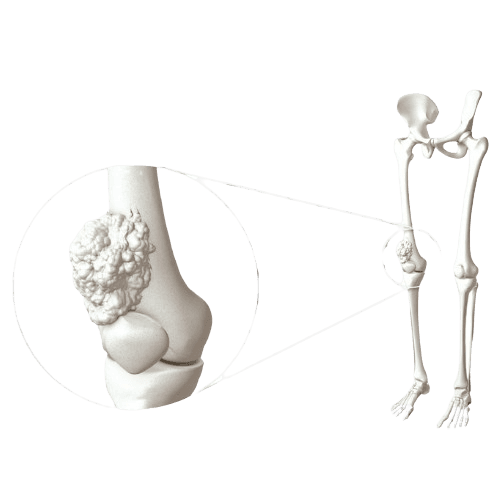
Overview
Bone cancer arises when cells within the bone multiply abnormally, forming a malignant tumor. It can start in the bone itself (primary) or spread from another site (secondary).
Early diagnosis and multidisciplinary management are key to improving outcomes.
Overview And Clinical Background
Bone cancer can affect any bone but is most common in the pelvis or long bones of the limbs.
It may cause pain, swelling, and weakened bone structure.
- Types:: Osteosarcoma, chondrosarcoma, and Ewing’s sarcoma are the main forms.
- Most cases require a biopsy to confirm diagnosis.
- Spread:: Advanced disease can metastasize to the lungs or other bones.
Symptoms, Signs And Presentation
Persistent bone pain, fractures without trauma, and localized swelling are typical presentations.
Symptoms worsen over time and may interfere with movement.
- Common symptom:: Bone pain, especially at night or during activity.
- Swelling or a visible lump near affected area.
- Red flag:: Unexplained fractures or sudden immobility.
Diagnosis Methods And Investigations
Imaging And Laboratory Tests
Diagnosis requires imaging and tissue confirmation.
MRI or CT scans identify tumor extent while biopsy confirms malignancy.
- Imaging:: MRI and X-ray help locate and size the lesion.
- Lab tests:: Blood markers like alkaline phosphatase may be elevated.
- Biopsy is definitive for diagnosis and histological classification.
Treatment Options And Surgical Techniques
Treatment is multidisciplinary—combining surgery, chemotherapy, and radiotherapy.
Goal is to remove tumor and preserve limb function.
- Conservative:: Pain control and physical support for early or palliative cases.
- Minimally invasive options:: Image-guided biopsies and targeted ablation for select cases.
- Limb-sparing surgery or amputation may be performed depending on extent.
Recovery, Risks And Prognosis
Recovery depends on tumor type, size, and treatment response.
Early intervention offers higher survival and limb preservation rates.
Why Choose Us
CureU Healthcare provides integrated orthopedic oncology care — expert surgeons, advanced imaging, and compassionate recovery planning.
Focused on mobility and long-term outcomes.
Conclusion
Bone cancer treatment is challenging but increasingly curable with precise, multidisciplinary management.
Early consultation is vital.