Overview
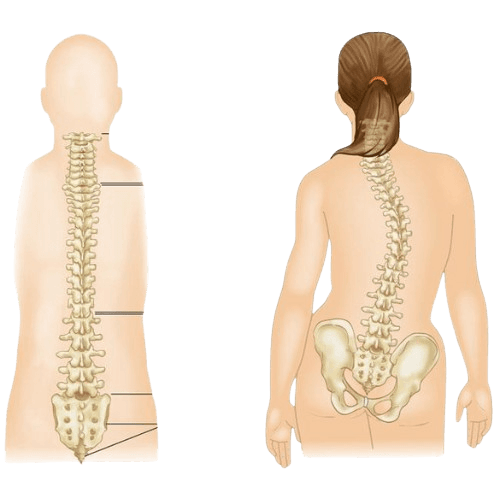
Adolescent Idiopathic Scoliosis (AIS) is a three-dimensional spinal curvature that commonly emerges between ages 10 and 18 without an identifiable cause.
Most curves are mild and monitored, but some progress during growth spurts and may affect posture, appearance, and — in severe cases — pulmonary function. Timely screening, accurate measurement, and age-appropriate management are the pillars of good outcomes.
Typical Age of Onset and Who Gets Affected
AIS typically appears around the adolescent growth spurt. Girls are more likely to have curves that progress to a degree requiring treatment, while boys may present later or with different curve patterns. Family history and rapid growth are commonly observed in patients who need closer follow-up.
How Scoliosis is Detected and Diagnosed
Diagnosis starts with a clinical screening — Adam’s forward bend test and inspection for asymmetry in shoulders, ribs, and waist.
Confirmatory imaging (standing full-spine X-rays) measures the Cobb angle and determines curve magnitude, location, and flexibility. Occasionally MRI is recommended to rule out underlying spinal pathology if atypical signs are present.
- Physical exam:: Adam’s forward bend test, shoulder/waist asymmetry assessment.
- X-rays:: Standing AP and lateral full-spine radiographs to measure Cobb angle.
- MRI when indicated:: Neurological findings, very early onset, or rapidly progressive curves.
Non-Surgical Management and When It Works
Observation, physiotherapy, and bracing are the mainstays for mild-to-moderate curves in growing adolescents. The goal is to stop progression while preserving spinal mobility and function.
- Observation & physiotherapy:: Regular monitoring plus posture and core-strengthening programs.
- Brace treatment:: Rigid or dynamic braces used when curve magnitude and skeletal maturity indicate risk of progression.
- Patient adherence and proper fit are decisive for success.
Surgical Indications and Typical Procedures
Surgery is considered when curves exceed thresholds (commonly >45–50°) or when progression threatens function or quality of life. Modern techniques aim for curve correction, durable fusion, and preservation of growth where possible.
- Posterior spinal fusion:: Most common — instrumentation and fusion to correct and stabilize the spine.
- Anterior procedures & growth modulation:: Used selectively in younger patients to control growth while preserving motion.
- Minimally invasive and neuromonitoring techniques reduce complications and speed recovery.
Expected Recovery and Long-Term Outlook
Recovery timelines vary: non-surgical paths emphasize continued monitoring; surgical patients usually mobilize within days and return to most activities in weeks to months. Long-term outcomes are generally excellent when treatment is timely and adherent, with most patients achieving stable correction and normal function.
Why Choose Us for Pediatric Spine Care
CureU Healthcare combines pediatric orthopedic expertise, growth-aware surgical strategies, dedicated physiotherapy, and a family-centered care model. We prioritize minimally disruptive treatments, evidence-based bracing, and recovery plans tailored to school and social life so kids don’t fall behind.
Conclusion
Adolescent Idiopathic Scoliosis is manageable if detected early and treated according to curve severity and growth potential. With the right team — from monitoring and bracing to modern surgical care when needed — children can expect good functional and cosmetic outcomes.


